SeatLayer vs seats.io: the seating layer, plus the ticketing behind it.
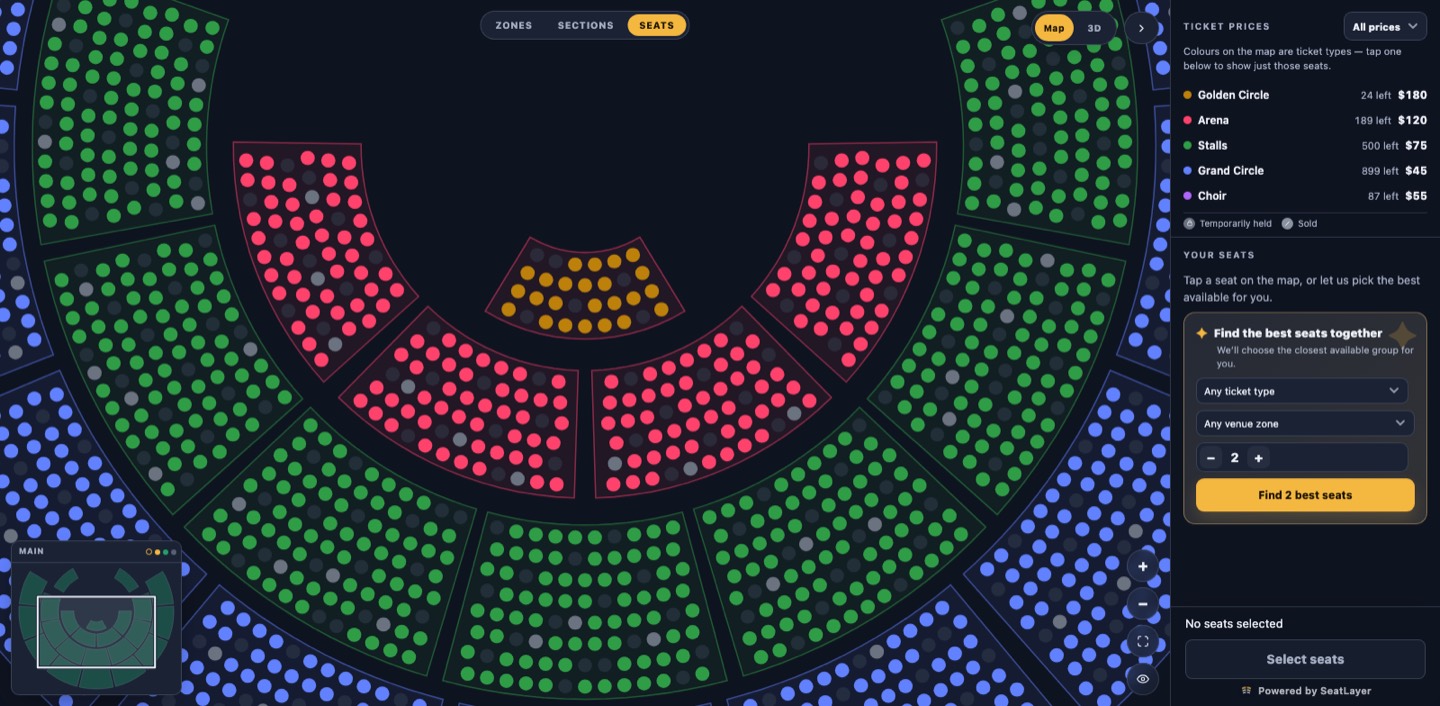
Both give you a seat map SDK for your own product. SeatLayer also sells the tickets if you want it to: checkout on your own website, a box office, refunds and door check-in. The seat price is lower too: $0.10 per confirmed sold seat, down to $0.05, with 100 free every month.
- Purchased credits never expire
- No subscription or minimum commitment
- 3D is included for every customer
Both have
- Web, mobile and server SDKs
- Embeddable Designer
- Live event manager
- Sales channels
- Season tickets
- Webhooks and REST API
SeatLayer adds
- Checkout on your own website
- 14 payment gateways, paid to you
- QR and PDF tickets
- Box office counter
- Refunds and door check-in
- Billing on sold seats only
SeatLayer and seats.io, feature by feature.
Both are reserved-seating infrastructure in SDK mode; SeatLayer can also run the whole ticket sale on the organizer's own payment gateway.
| Feature | SeatLayer | seats.io |
|---|---|---|
| SDK pricing: seat map in your own product | ||
| Price per seat | $0.10 → $0.05per sold seat | €0.18per used seat, Silver |
| What counts | Sold seats onlyheld or abandoned seats are free | Used seatsselected, booked or assigned |
| Unused seats | Never expire | Expireat the end of the plan period |
| Plan or contract | None100 free sold seats a month | Monthly or yearly planSilver €450 a year |
| Build the venue | ||
| Free chart maker | Yesstart without signing up | Not stated |
| Venue templates | 58 free templatestheatres, arenas, stadiums, clubs | Not stated |
| AI builds the chart | From a description or a floor planCopilot, ChatGPT, Claude or your own agent over MCP; you review before publishing | Not stated |
| Import existing plans | PDF, SVG and DXFtrace a PDF or bring vector shapes | Plan imagetrace it, or scan for seats |
| Rows, sections, tables, booths, GA | Yeswith floors | Yeswith floors |
| Accessible seats | Yesshown to buyers as a filter | Yes |
| Buyer experience | ||
| Buyers pick seats on phone and desktop | Yestouch and pinch-to-zoom | Yes |
| Best available | Yes | Yes |
| 3D and view from seat | Every chart, automaticallyon every plan, no conversion step | Opt-in since 22 Sep 2026each chart converted in the designer |
| Buyer languages | 37 | 37 |
| Stadium scale | 200,000 seats in 1.95 s10,000 buyers at once, 9 ms hold | Published case studies |
| Hosted ticketing: sell on your own website | ||
| Price per ticket | $0.50no percentage, first 25 free | Not offered |
| Checkout on your website | Yespaid into your own gateway | Bring your own |
| Payment gateways | 14, paid to your accountStripe, PayPal, Square and 11 more | Bring your own |
| QR and PDF tickets | Yesemailed for every seat | Bring your own |
| Box office counter | Yessame live map, 80 mm or A4 | Bring your own |
| Refunds | Yesa whole order or one ticket | Bring your own |
| Door check-in | Yesthe SeatLayer app for iPhone, or a phone browser | Bring your own |
| WordPress plugin | Freeblock or shortcode | Not stated |
| For platforms | ||
| Web, mobile and server SDKs | YesReact, Vue, Angular, iOS, Android, Flutter, RN | Yes |
| Embed the Designer | Yesin your own admin | Yes |
| Embed a live control panel | Yessales, holds and blocks in real time | Event Manager |
| Sales channels | Yespartners get their own login and reports | Yes |
| Season tickets | Yes2 to 20 events, same seat, renewals | Yes |
| REST API and webhooks | Yessigned webhooks | Yes |
| AI agents (MCP) | Build the chart, then run the eventPrices, holds and blocks, partner sales and reports. Changes to an event on sale wait for your yes. | Not stated |
| Large accounts | ||
| Custom agreement | Above 100,000sold seats a month | From 20,000used seats a month, with minimums |
IncludedNot includedNot stated by seats.ioseats.io facts from its public pages, checked September 2026
Check it yourself: Quickstart OpenAPI SDK source on GitHub Live demo venues
- 200,000seats on one map, ready in 1.95 sOpen the stadium →
- 100,000seats in a public arena you can tryOpen the arena →
- 10,000buyers on one event, zero server errors
- 9 msto hold a seat under that load (p99)
Tested on public venue files with simulated buyers, September 2026. How we measured loading · How we measured buyers · Every run on GitHub
Already on seats.io?
Upload your floor plan and click it into a SeatLayer chart, then run both side by side before you switch.
Try SeatLayer on a real venue.
Use the public 200,000-seat stadium, 100,000-seat arena, shared 2D/3D journey, and JavaScript seating chart guide.
Use SeatLayer the way your business works.
Start with one way and add more later. It is the same venue chart and the same live seats every time, so nothing has to be rebuilt.
Sell on your own website
Checkout on your page, paid into your own gateway. $0.50 a ticket.
Sell on your website →WordPress plugin
Free plugin. Pick the event from a list and the seat map appears on the page.
Get the plugin →Inside your own product
Add the seat map to your platform with the SDK. Your server keeps checkout and orders.
See the SDK →In your mobile app
Native SDKs put the same seat map inside your iPhone and Android apps.
Mobile SDK guide ↗Under your brand
Embed the Designer and the live control panel so your organizers never leave your product.
For ticketing platforms →Through partners
Give sponsors and agencies their own seats and login, and track each channel.
See sales channels →At the box office
Staff sell from the same live map and print tickets on 80 mm or A4.
See the box office →Built with AI
Describe the venue to Copilot, ChatGPT or Claude, upload a floor plan, or let your own agent build it over MCP and set up the event. No chart tool to learn, and you review before anything is published.
See what an AI can build and run →
SeatLayer vs seats.io questions
Still have a question? or email hello@seatlayer.io.
Are SeatLayer and seats.io complete ticketing systems?
How does SeatLayer pricing compare with seats.io?
Can SeatLayer run the box office and the door as well?
Is 3D included with SeatLayer?
Which is the better fit for a large concert or stadium?
Do SeatLayer and seats.io support similar SDK stacks?
How do I move from seats.io to SeatLayer?
Can I embed a live control panel like the seats.io Event Manager?
Does SeatLayer have a free plan?
Run the same reserved-seating job in both systems.
Use one real venue and one on-sale. Judge buyer navigation, live state, the box office and door, and what each product bills for before changing vendors.