The seats.io alternative that bills when you sell.
A seats.io alternative that charges when you sell, not when you use. Same job — design a venue, protect live inventory, let buyers pick real seats — with a sharper economy, a buyer layer you don't have to build, and an open chart format so switching isn't a one-way door. Honest about where seats.io still leads.
You pay when a seat sells — not for every seat you use.
SeatLayer spends a credit only when a seat actually sells; seats.io meters every used seat on monthly tiers. On a real on-sale, that gap is what your invoice remembers. Holds, blocks, abandoned carts and rendering never cost a credit here. seats.io's exact rates live on their page — they change, and they're the authority — so this compares the models, not the digits.
- 100 free sold seats every month.
- Packs taper from 8¢ down to a 5¢ floor at ~100,000 seats/mo; enterprise beyond 100K.
- Credits never expire — no monthly minimum, no annual commitment.
- Holds, blocks, abandoned carts and rendering are always free.
- Billed on used seats rather than seats that convert to a sale.
- Tiered monthly pricing with an enterprise band at higher volume.
- Mature billing around a long-established platform.
- See seats.io's site for their current rates — they're the authority on their own pricing.
seats.io pricing model as publicly described, July 2026.
A buyer experience you don't have to build or photograph.
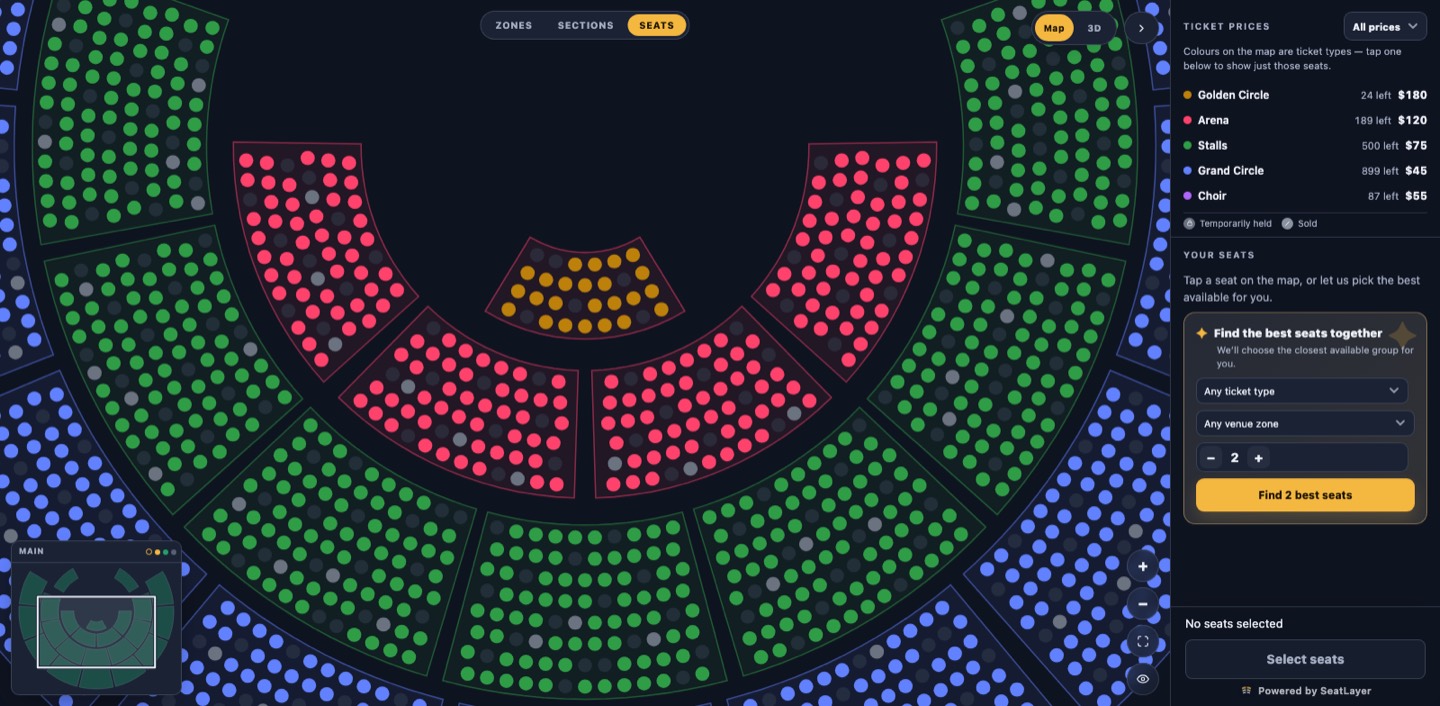
Most of SeatLayer's buyer experience is generated, not assembled. The chart already knows where every seat sits, so the 360° view, the accessibility filters and the reveal timing come out of that geometry instead of a photo shoot or a scheduled job. The view-from-seat on the right is drawn live from the chart.
- Auto 360° view-from-seatEvery seat gets a generated view from the chart geometry — no organizer photos to source, upload or maintain.
- 3D stacked multi-floorSwitch floors in 2D or view them as stacked 3D decks, so a buyer understands a balcony sitting above an orchestra.
- Auto-reveal inventory at % soldRelease held seats when demand crosses a threshold you set — a demand trigger, not just a timer.
- 8-type accessibility taxonomyFirst-class CART plus wheelchair, companion and other accommodations generate buyer filters automatically; wheelchair places distinguish a physical seat from an empty sellable bay.
- Seat flags in the pickerMark seats restricted, obstructed or premium and attach an organizer note — surfaced to buyers before they commit.
Everything you embed on seats.io, you embed here.
If you integrated seats.io, the shapes are familiar — a designer to author charts, a picker to sell them, and an API and events to own inventory. SeatLayer gives you all three, plus a live control room you can embed white-label into your own product.
Embedded designer
Drop the full venue Designer into your own product with short-lived scoped sessions, so your customers author their own charts — white-label, no redirect.
Embedded control room
Not just the buyer picker — embed the live event control room too, so operators hold, sell and block seats in realtime from inside your app.
Picker SDK — JS & React
Ship the buyer picker as a CDN script, a React component or a zero-code iframe — under 150 KB gzipped, protecting live inventory over WebSocket.
The main seats.io competitors, compared honestly.
“seats.io alternative” covers a few very different products, and the right one depends on the job. Some are full ticketing platforms, some are 3D-render specialists, and only a couple are embeddable seating layers you drop into your own product. Here's the short version — SeatLayer first, then the closest peers, each with the job it's genuinely best at.
SeatLayer
Embeddable reserved-seating infrastructure: a white-label venue Designer, a live control room, and a picker SDK sharing one chart and one inventory authority — billed only when a seat sells.
seatmap.pro
A developer-first seat-map SDK with a REST and booking API, and publicly documented realtime seat locking (WebSocket lock-then-confirm). The closest peer to SeatLayer in shape.
Ticket Tailor
A full self-serve ticketing platform — checkout, payments, order management and marketing — with its own reserved-seating support built in, not a layer you embed elsewhere.
3D Digital Venue
A specialist in photoreal 3D venue visualisation and view-from-seat renders for flagship stadiums and arenas, sold as a high-end visual product.
Third-party roundups (Capterra, AlternativeTo, SourceForge) also list broader ticketing tools like Purplepass, Nutickets and Ticket Tailor under “seats.io competitors.” Most are full platforms; SeatLayer and seatmap.pro are the two that sit as an embeddable seating layer. For the row-by-row detail, open the full SeatLayer vs seats.io comparison.
Rebuilding your charts costs nothing until a seat sells.
Rebuilding your charts is free, so the migration itself carries almost no risk. The concepts you know from seats.io carry over, the format holds nothing hostage, and you can stand a venue up alongside your current one and compare before committing a cent.
- Free to rebuild your venuesDesign, hold, block and render buyers without spending a credit — start from 50 templates or the no-login demo, not a blank grid.
- Concepts map closelyCharts, categories, holds and bookings behave the way you'd expect coming from a seating SDK — the mental model carries over.
- Open, exportable formatEvery chart is a portable document — geometry, categories and accessibility data. Export anytime; there's no proprietary runtime to migrate off later.
- Run both in parallelBecause you only pay when a seat sells, keeping SeatLayer alongside your current vendor while you compare costs nothing.
50 templates open straight into the Designer.
Theatres, arenas, banquet rounds, exhibition halls — rebuild from a real layout, not a blank canvas, and publish in an afternoon.
Four times seats.io is the better call today.
A switching page that admits no downside isn't worth your time. So here's the honest four: if any of these is a hard requirement today, seats.io is likely the right choice, and better to find that out now than mid-migration.
seats.io also reports a longer history and high uptime. If contractual scale or an SLA is non-negotiable, weigh that honestly. And if you can't tell which side of the line you land on, talk to us — you'll get a straight answer.
seats.io alternative FAQ.
Is it free to design charts on SeatLayer?
Yes. Designing venues, holding seats, blocking sections and rendering the buyer picker are all free — start from 50 templates or the no-login demo. A credit is only spent when a seat actually sells, and you get 100 free sold seats every month. Credits never expire, and there's no monthly minimum or annual commitment.
How do I migrate from seats.io?
You rebuild charts in the SeatLayer Designer — for free — using its 50 templates and the no-login demo, then embed the picker with a script tag, React component or zero-code iframe. The chart format is open and exportable and the concepts map closely (charts, categories, holds, bookings), so you can build a venue in parallel and compare. Because you only pay when a seat sells, running both side by side costs nothing until you cut over.
What's not covered — where does seats.io still win?
SeatLayer doesn't yet offer seasons and season tickets, sales channels and allocations, or resale and re-listing flows. seats.io reports scale into 80,000-plus-seat venues and a longer track record; SeatLayer uses automatic level-of-detail but does not yet publish an equivalent browser frame-time benchmark. If any of those is a hard requirement today, seats.io is the safer pick — see the full SeatLayer vs seats.io comparison.
How does the pricing compare to seats.io?
They meter different things. seats.io charges per used seat on monthly tiers; SeatLayer charges per sold seat in flat credits — 1 credit = 1 sold seat, 8¢ down to a 5¢ floor at 100,000 seats/mo, 100 free every month, credits never expire, holds and blocks free. Check seats.io for their current rates and our pricing page for the full ladder.
Will I be locked in if I switch?
No. Every chart is an open, exportable document — geometry, categories and accessibility data — and the buyer renderer is a plain script tag, not a proprietary runtime. You can export at any time, so choosing SeatLayer isn't a one-way door. For the full positioning, see Why SeatLayer.
Who are the main seats.io competitors and alternatives?
They fall into three groups. Embeddable seating layers you drop into your own product: SeatLayer and seatmap.pro — seatmap.pro is a developer-first seat-map SDK with a booking API and documented realtime locking, while SeatLayer adds an embedded designer, live control room and per-sold-seat billing. Full ticketing platforms that sell the tickets end to end: Ticket Tailor, Purplepass, Nutickets. And 3D-render specialists for flagship venues: 3D Digital Venue. If you want the seating layer inside your own checkout, SeatLayer and seatmap.pro are the closest peers; the others do more but aren't embeddable seating layers.
Try a seats.io alternative against your real venue.
Rebuild a chart for free, operate a live buyer picker and control room with no login, and pay nothing until a seat sells. Then decide from the running product, not from a page trying to win you over.