See the venue before you buy the seat.
Orbit the whole room, fly to any seat, look around from it. Built from the same published chart — no second model to maintain. Optional, loads only when opened; the 2D map is always one tap away.
SeatLayer is 3D seat map software for ticketing: buyers orbit the venue in 3D, fly to any seat, and preview the view from that seat before buying — driven by the same published seating chart as the 2D picker. A seat picked in 3D is the seat in the cart, the hold and the webhook, and opening the 3D venue never uses another sold-seat credit.
One seating chart powers 2D and 3D
The 3D venue is derived from the chart you already publish: row and tier geometry become the bowl, and the landmarks the Designer knows about — stage, screens, walls, rails, suites, entrances — become the room around it. Nothing is modelled twice.
- Published 2D chartSections, rows, seats, tables, floors, price zones — the chart buyers already pick from.
- Geometry + landmarksRow curves, tiers and floors give the bowl its shape; Designer landmarks place the stage, screens, rails and suites.
- 3D venueOrbit, fly to any seat, look around. Held, sold and not-for-sale states and your theme carry straight through.
- Same selection stateA seat picked in 3D is the seat in the cart, the hold and the webhook.
- No second chargeOpening 3D never uses another sold-seat credit — one sold seat, one credit.
- Finds the seat in a big bowlSection → Row → Seat locator frames each level, highlights the seat, then offers the view from it.
A 3D view from any seat in the venue
Orbit → fly → look around: a 3D seat view lets buyers pick a seat in 3D, fly to it and see the view before they pay. Real photos or panoramas where the venue has them; a generated preview that says so where it doesn’t. More on the view from any seat and where its media comes from, on what 3D ticketing means as a category, and on how this compares with 3D Digital Venue.
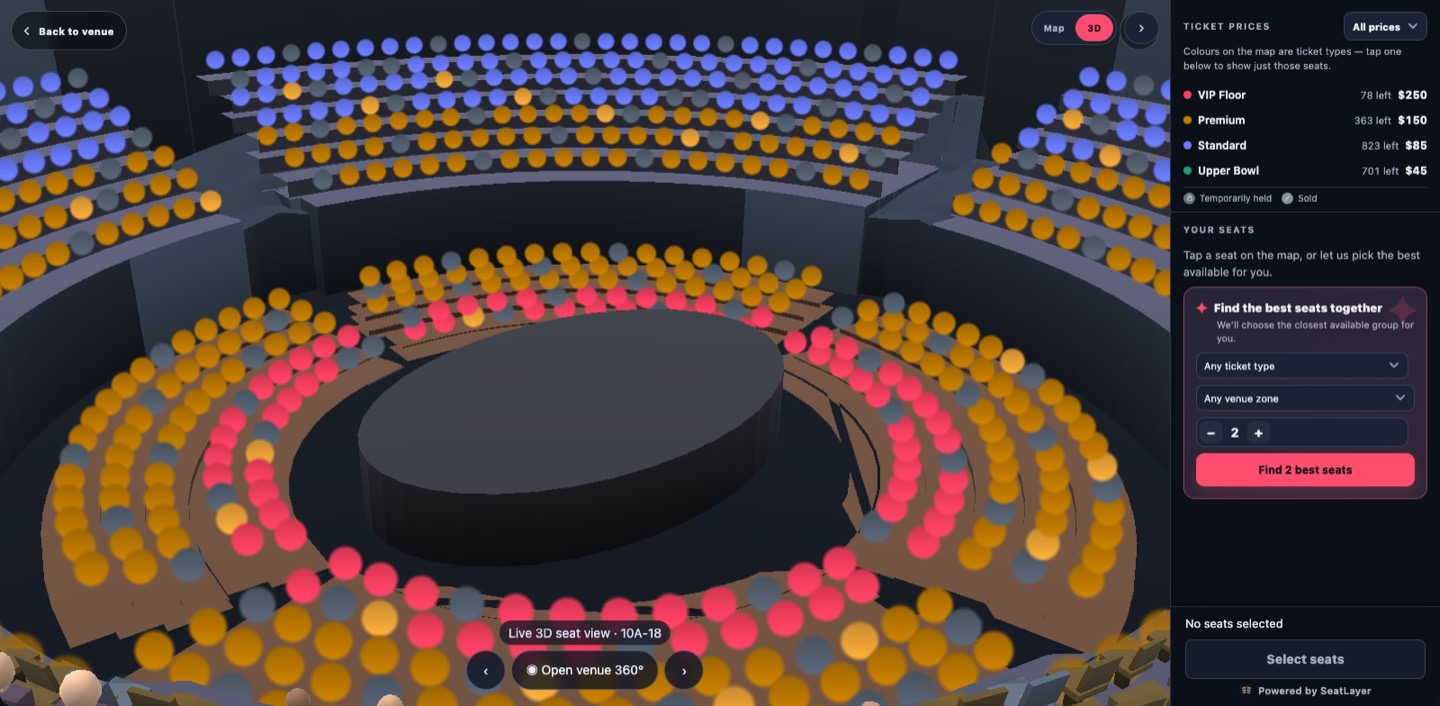
Real venue photos and panoramas where organisers have them. Generated previews always say so — this demo uses a clearly labelled AI-generated panorama, not a certified sightline.
Six venues, live.
Each demo opens the buyer picker on a published template, with the 3D venue, seat selection, and the view from a seat in one picker session.
At 53,018 seats the buyer renderer measured 17.6 ms p95 frames while panning, zooming and selecting in the disclosed desktop benchmark. The venue was on screen in 348 ms and every seat was drawn within 4.3 s while it stayed interactive; the flat-to-3D transition measured a 34.2 ms p95 frame. Measured 27 Aug 2026. Method, numbers and limitations: Read the benchmark method
Open the 53,018-seat public demo and test it yourself: Try the 53,018-seat stadium
53,018-seat bowlTHE SAME 3D VIEW AT STADIUM SCALE · SECTION → ROW → SEAT LOCATOR
Open in 3D →
For developers: on in one line.
const picker = new SeatPicker({
  container: "#picker",
  event: eventKey,
  publicKey,
  enable3D: true,
  seatView: true
});

await picker.render();

// Buyers get Map / 3D; you can drive it too.
picker.setBuyerView("venue3d", { flyToSeatId: seat.id });
picker.setBuyerView("map");

// enable3D: false keeps the complete 2D map only.- Loads only when a buyer opens it, so the initial map does not load 3D assets.
enable3D: falseorseatView: falseswitch each part off. - Needs a capable browser (WebGL2); otherwise the complete 2D map. On phones the demo opens full-screen and the picker keeps the same Map / 3D switch.
onBuyerViewChangegives you the view and seat, so a route can restore or share it.- Respects reduced-motion; keyboard users keep Map/3D and the tour controls.
3D seat map software: common questions
Does the 3D view replace the 2D map?
No. The 2D map stays the complete way to browse prices, find a section and pick an exact seat, and it is always one tap away. The 3D venue is another view of the same seats, offered when the browser can run it.
What happens on an older browser?
The buyer gets the complete 2D map. SeatLayer offers 3D only when the browser can render it (WebGL2) and the chart and device suit it. Checkout never depends on entering 3D.
Where do the panoramas come from?
From the venue, wherever it has them. Organisers upload photos or panoramas at seat, row, section, floor or venue level and the closest one to the chosen seat wins. Where nothing has been uploaded, SeatLayer can show a preview built from the chart geometry, which says on its face that it is generated.
Can I open 3D from my own interface?
Yes. setBuyerView("venue3d") opens the venue and the flyToSeatId option focuses a seat the buyer has already chosen. The built-in Map / 3D control also works with no host code at all.
Does 3D cost extra?
No. One confirmed sold seat uses one credit whether the buyer chose it on the 2D map or in 3D; opening the 3D venue or the view from a seat never uses another credit.
Does it work on phones?
Yes. The same picker offers Map / 3D on a phone; the demo on this page opens the venue full-screen there. Panoramas load progressively so a light preview paints first, and the 2D map stays one tap away.
Is 3D available in the hosted flow?
Yes. Hosted checkout runs the same published chart and the same buyer picker, so the 3D venue and the view from a seat behave there exactly as they do in an embedded picker.
What is 3D seat map software?
It renders the venue itself in three dimensions so buyers can orbit the room, fly to a seat and look around from it before they pay. SeatLayer derives the 3D venue from the seating chart you already publish — row and tier geometry become the bowl, and Designer landmarks such as the stage, screens, walls, rails, suites and entrances become the room around it — so nothing is modelled twice. It is optional: it loads only when a buyer opens it, and the complete 2D map stays one tap away.
Can buyers see an event seating plan in 3D before buying?
Yes. The buyer picker offers a Map / 3D switch on desktop and on phones, and held, sold and not-for-sale states and your theme carry straight through. A seat picked in 3D is the seat in the cart, the hold and the webhook, and the same journey runs in hosted checkout. Where the browser cannot render 3D (WebGL2), the buyer gets the complete 2D map and checkout is unaffected.