SEATLAYER VS SOCIAL TABLES

SeatLayer vs Social Tables: live seat sales or event planning.

Start with SeatLayer when buyers must select live, purchasable seats. Choose Cvent Event Diagramming, formerly Social Tables, when teams must plan a room, place known attendees, coordinate meals and registration, or present a photorealistic design.

Discuss transactional seating →

Honest boundary: SeatLayer is not a guest-list, meal, BEO, or photorealistic planning system. Social Tables' documented Cvent integrations are real strengths. Both products can support enterprise customers; their primary jobs differ.

TWO DIFFERENT JOBS BUYER SELECTION VERIFIED 11 AUG 2026
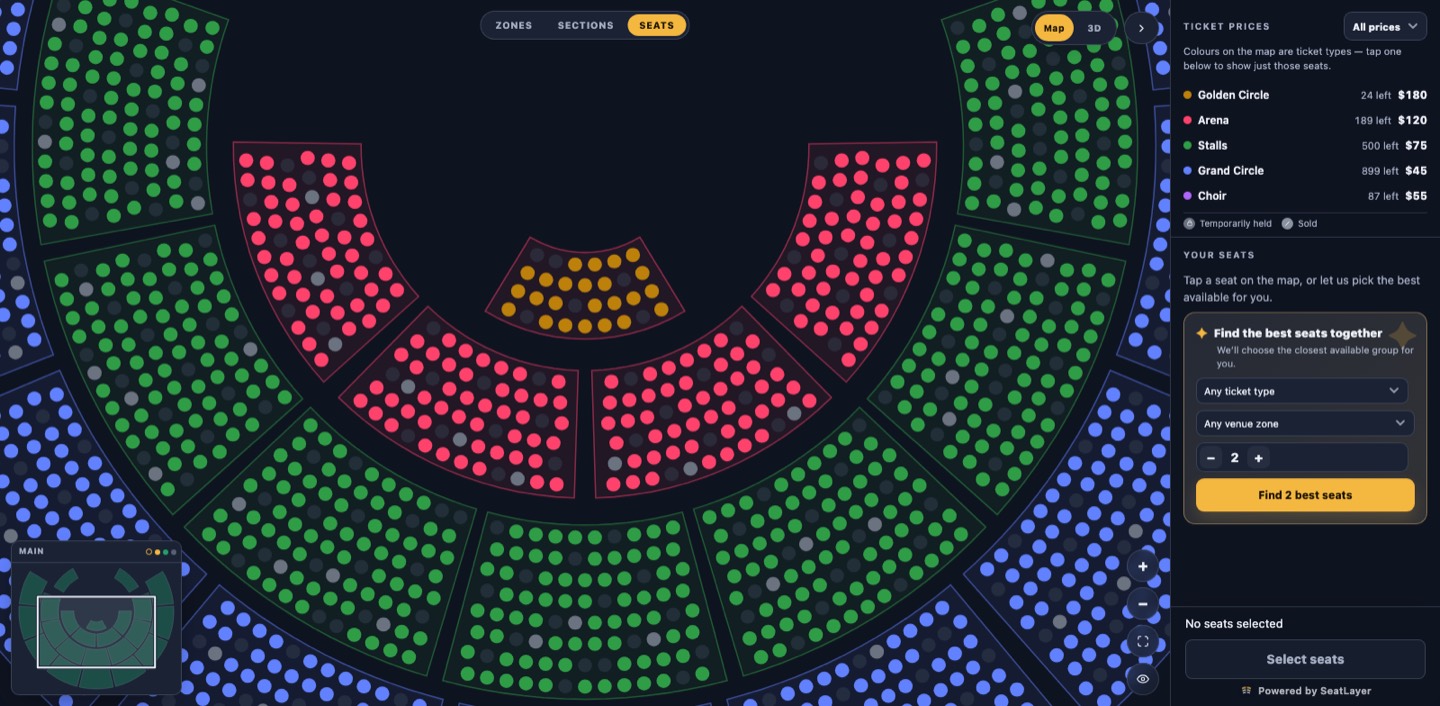
GRAND THEATRE · BUYER MAP RELEASED PRODUCT
SeatLayer buyer picker selling assigned seats from an interactive seating chart with live inventory — the transaction Social Tables room planning does not carry
Current SeatLayer buyer seating chart · captured from the public demo 25 Aug 2026
4 stable web pathsJS/TS · React · Vue · Angular
7 server SDKsplus REST/OpenAPI and webhooks
Credits never expirepay for confirmed sold seats
2 product pathsSDK ownership · hosted operations
CHOOSE THE JOB FIRST

Different products serve three seating workflows.

A “seating chart” can arrange guests, sell inventory, or simply document a room.

CHOOSE SEATLAYER WHEN

The buyer chooses from live inventory.

  • Each seat, table, desk, or spot has a purchasable state.
  • Selection belongs inside a product and checkout you control.
  • Buyer, counter, and operator surfaces need one inventory truth.
  • Your trusted server must hold and book the selected inventory.
CHOOSE SOCIAL TABLES WHEN

You already know who is attending.

  • Planners and venues need to collaborate on a room diagram.
  • Named guests must be assigned to tables or seats.
  • Meal, registration, and onsite information belong with the guest plan.
  • A photorealistic walkthrough helps present the room to a client.

Only need to create and share a non-transactional chart? Use the free seating chart maker. It owns free, printable, wedding, classroom, and simple maker intent.

THE TRANSACTIONAL SEATING JOURNEY

Author the venue once. Carry it into every seat decision.

SeatLayer separates reusable venue geometry from event seat state, then carries both into buyer and operator surfaces.

VENUE GEOMETRY

Keep curves, levels, sections, tables, booths, and GA editable.

Venue intent remains structured, reusable, and ready for different events.

Explore Venue Designer →
EVENT INVENTORY

Give authorized surfaces the same free, held, sold, and blocked state.

Operational decisions and buyer availability stay connected to one event.

See box-office operations →
BUYER CONTROL

Embed the buyer journey in JavaScript, React, Vue, or Angular.

Seven server SDK families, REST/OpenAPI, webhooks, and real-time inventory support the browser path. Hosted reserved seating remains a separate secondary path.

Compare event ticketing platforms →
COMPARE THE FEATURES THAT MATTER

Compare the operating model—not the word “seating.”

Current official product, pricing, integration, and learning pages were reviewed 5 Sep 2026. “Not presented” describes only those reviewed public surfaces.

Decision SeatLayer Social Tables / Cvent Event Diagramming
Primary job Buyer-facing reserved-seating infrastructure, led by an SDK inside another booking product, with a separate hosted path. Collaborative event diagramming and known-attendee planning for planners, venues, and hospitality teams.
Who gets placed Public buyers choose available inventory during a booking journey. Planning teams place named attendees they already know.
Venue authoring Reusable structured venue geometry with sections, levels, rows, tables, booths, GA, categories, publishing, and embeddable Designer. To-scale event-space diagrams, 700+ objects, collaboration, source-plan upload, attendee placement, and venue-planner workflows.
Buyer transaction Stable JavaScript/TypeScript, React, Vue, and Angular SDKs put selectable seats inside a host-controlled booking flow. The reviewed pages document attendee management and Cvent Registration integration, but not Event Diagramming itself as a public transactional seat-picker SDK.
Live inventory and holds Event-specific free, held, sold, and blocked state shared in real time across authorized buyer and operator surfaces. Not presented in the reviewed pages as buyer-purchasable free, held, sold, and blocked inventory.
SDK, API, and events Four stable web paths, seven server SDK families, and four production mobile SDKs, plus REST/OpenAPI and signed webhooks. Deep Cvent ecosystem integration is documented; the reviewed public pages do not present an external transactional seat-picker SDK.
Checkout and channels Keep checkout in your product, or use SeatLayer's hosted event, Box Office, Control Room, ticket, and door-tool path with organizer-connected Stripe or Razorpay. Cvent Registration, OnArrival, and Badges integration can connect planning, registration, assignments, and onsite operations.
3D purpose Optional chart-derived interactive buyer 3D adds live selection and venue orientation while the complete 2D path remains available. Photorealistic 3D helps planners, venues, and clients visualize and present an event-space design.
Entry pricing 100 free Platform/SDK credits every month, then $50 for 500 confirmed-sold-seat credits at $0.10 each, with no subscription or minimum commitment. Planner plans reviewed 5 Sep 2026: Free; Standard $49/month; Pro $150/month; Premium $320/month; Enterprise custom.
Unused value Purchased credits never expire. If no seats sell, no sold-seat credits are consumed. All paid plans have a 12-month commitment. This is a licensed planning plan, not a prepaid seat-credit bucket, so “credit rollover” is not a like-for-like claim.
Enterprise and integrations Enterprise terms, SDK/API deployment, released sales channels, and embeddable control surfaces are available. Enterprise plans, training, advanced features, unlimited plan allowances, and Cvent ecosystem integrations are documented.
Best fit Platforms and organizers selling selectable live inventory with product ownership or a specialist hosted seating path. Planners and venues designing events, assigning known attendees, managing meal details, and presenting room layouts.
Deliberate boundary No guest-list-to-table assignment, meal or BEO workflow, or photorealistic planning walkthrough. Not positioned in the reviewed sources as a specialist external transactional seating engine.
VERIFY SEATLAYER

Inspect our SDKs, pricing, source, docs, and released product.

Every link here points to SeatLayer-owned product evidence or SeatLayer's public GitHub repositories.

Pricing in plain terms: Social Tables licenses event-planning software; SeatLayer meters confirmed sold seats, so the prices describe different jobs. Official Cvent sources are linked below.

WHAT ADOPTING A SEATING LAYER REQUIRES

This is a new transaction path—not a diagram export trick.

SeatLayer does not claim to import a Social Tables account or synchronize its guest list. Build the buyer-facing seating flow explicitly.

  1. 01

    Recreate and review the venue.

    Start from a released template or author the structure in the Designer. Verify sections, categories, accessibility, and commercial view metadata.

  2. 02

    Create event inventory.

    Attach event-specific free, held, sold, and blocked state without changing the reusable venue chart.

  3. 03

    Connect buyer and server.

    Embed JavaScript/TypeScript, React, Vue, or Angular; create a hold; take payment in your system; and book from your trusted server SDK or API.

Keep planning where it fits: using Social Tables for internal guest or room planning and SeatLayer for public seat sales can be a valid coexistence model. No automatic data synchronization is implied.

3D FOR A DIFFERENT PURPOSE

Orient a buyer without removing the complete 2D path.

SeatLayer's 3D is transactional buyer context; Social Tables' 3D is event-planning and venue presentation. SeatLayer adds live selection and orientation while the complete 2D picker remains available. Neither purpose should be confused with the other.

2D firstSelection, accessibility, and transaction remain complete without WebGL.
Optional contextBuyers can understand stacked decks, venue orientation, and section relationships.
One venue model2D authoring, optional 3D, buyer selection, and operations keep the same structure.
Evaluate the optional 3D journey →
Sources

Cvent Event Diagramming · Cvent pricing

SOCIAL TABLES ALTERNATIVE QUESTIONS

Choose the operating model before the feature list.

Which is better: SeatLayer or Social Tables?
Choose SeatLayer when public buyers must select live purchasable seats inside your product or a SeatLayer-hosted flow. Choose Cvent Event Diagramming, formerly Social Tables, when planners and venues need collaborative room design, known-attendee placement, meals, BEO-oriented planning, Cvent registration workflows, or photorealistic presentations. Both can support enterprise customers; they solve different primary jobs.
Can Social Tables sell reserved seats to public buyers?
The official pages reviewed 5 Sep 2026 document event diagramming, known-attendee seating, check-in on qualifying plans, and deep Cvent Registration, OnArrival, and Badges workflows. They do not present Event Diagramming itself as a public buyer choosing live purchasable seat inventory or as an external transactional seat-picker SDK.
Which tool is better for wedding or banquet guest assignment?
Social Tables is the stronger fit when you already know the guests and need collaborative room planning, table assignment, meal management, registration synchronization, or a photorealistic walkthrough. SeatLayer does not claim guest-list-to-table assignment or BEO planning.
Can we import a Social Tables diagram into SeatLayer?
SeatLayer does not claim an automatic Social Tables importer or guest-list synchronization. Recreate and verify the venue in SeatLayer, then create event inventory and connect the buyer picker to your booking flow. The two products can also coexist for internal planning and public seat sales.
What SDK and API support does SeatLayer provide?
SeatLayer publishes stable JavaScript/TypeScript, React, Vue, and Angular web SDKs, seven server SDK families, production React Native, Flutter, iOS/Swift, and Android/Kotlin SDKs, REST/OpenAPI, signed webhooks, real-time event inventory, and embeddable Venue Designer and Control Room surfaces. In SDK mode, your product remains authoritative for checkout, payment, orders, customers, tickets, refunds, and support.
What is Social Tables used for?
The official pages reviewed 5 Sep 2026 present Cvent Event Diagramming, formerly Social Tables, as collaborative to-scale room design with known-attendee placement, meal information, Cvent Registration integration, qualifying-plan check-in, reporting, and photorealistic 3D. It is event-planning and venue-presentation software, not merely a seating chart.
How much does Social Tables cost?
As reviewed 5 Sep 2026, Social Tables planner plans are Free, Standard at $49 per month, Pro at $150 per month, Premium at $320 per month, and custom Enterprise; all paid plans carry a 12-month commitment and plan limits vary. Every Platform/SDK organization receives 100 free SDK seat credits each month; after that, $50 buys 500 confirmed-sold-seat credits at $0.10 each, with no subscription or minimum commitment, and purchased credits never expire. These units are not interchangeable: one licenses planning software and the other meters a transactional seating layer.
Is there a free alternative to Social Tables?
For drawing and exporting a simple chart, SeatLayer's free seating chart maker works without an account. It is not a like-for-like replacement for Social Tables because it carries no guest list, meal workflow, Cvent registration synchronization, collaborative venue-planner process, or photorealistic client walkthrough.
TEST THE BUYER JOURNEY FIRST

Test a venue in the checkout you operate.

Keep Social Tables for known-guest planning if it fits. Evaluate SeatLayer with the transaction it is actually built to power: live reserved-seat selection.

Discuss the integration →